

Spray vs Brush Cabinet Painting: Which Finish Actually Lasts in a Twin Cities Kitchen
Spray vs brush-and-roll cabinet painting in the Twin Cities: why sprayed cabinets look smoother and hold up, when brushing is fine, and how Gene actually finishes a kitchen. Call (612) 419-2789.
- 5.0 ★ · 104 Google reviews
- Serving the Twin Cities for 16 Years
- Free, No-Pressure Estimates
Why Choose Prestige WallWorX
Spray vs brush-and-roll cabinet painting in the Twin Cities: why sprayed cabinets look smoother and hold up, when brushing is fine, and how Gene actually finishes a kitchen. Call (612) 419-2789.

Spray vs brush cabinet painting is the question almost every homeowner asks us once they have decided to refresh the kitchen instead of replacing it, and the honest answer is that the method matters far less than most people think and far more than the paint can label will ever tell you. What people are really asking is two things at once: will sprayed cabinets look smoother, and will they actually last longer than brushed ones. We spray doors and drawer fronts on cabinet jobs across Victoria, Chanhassen, Edina, and the rest of the southwest metro, and Gene has been finishing cabinets this way for 16 years. Here is the part that surprises people: a sprayed finish and a carefully brushed finish, if both get the same degrease, the same scuff-sand, and the same bonding primer underneath, will last about the same length of time. The spray wins on how the surface looks. The prep wins on how long it lasts. Prestige WallWorX is owned and run by Gene out of Victoria, and we will tell you straight which method your kitchen actually needs.
Spray vs brush cabinet painting: what each method really does
Spraying atomizes the enamel into a fine mist that lands as a thin, even film and levels out flat before it flashes off, which is why a sprayed door reads factory-smooth with no stipple and no ridge lines. Brushing and rolling lay the enamel on with a tool that leaves its own texture behind: a brush leaves fine ridges, and even a good foam roller leaves a light orange-peel stipple. On the flat face of a cabinet door, that texture catches side light and shows. On a face frame or an inside corner, where nobody runs a hand and the light rakes less, it barely registers. That is the real distinction, and it is not about durability. It is about where the eye lands.

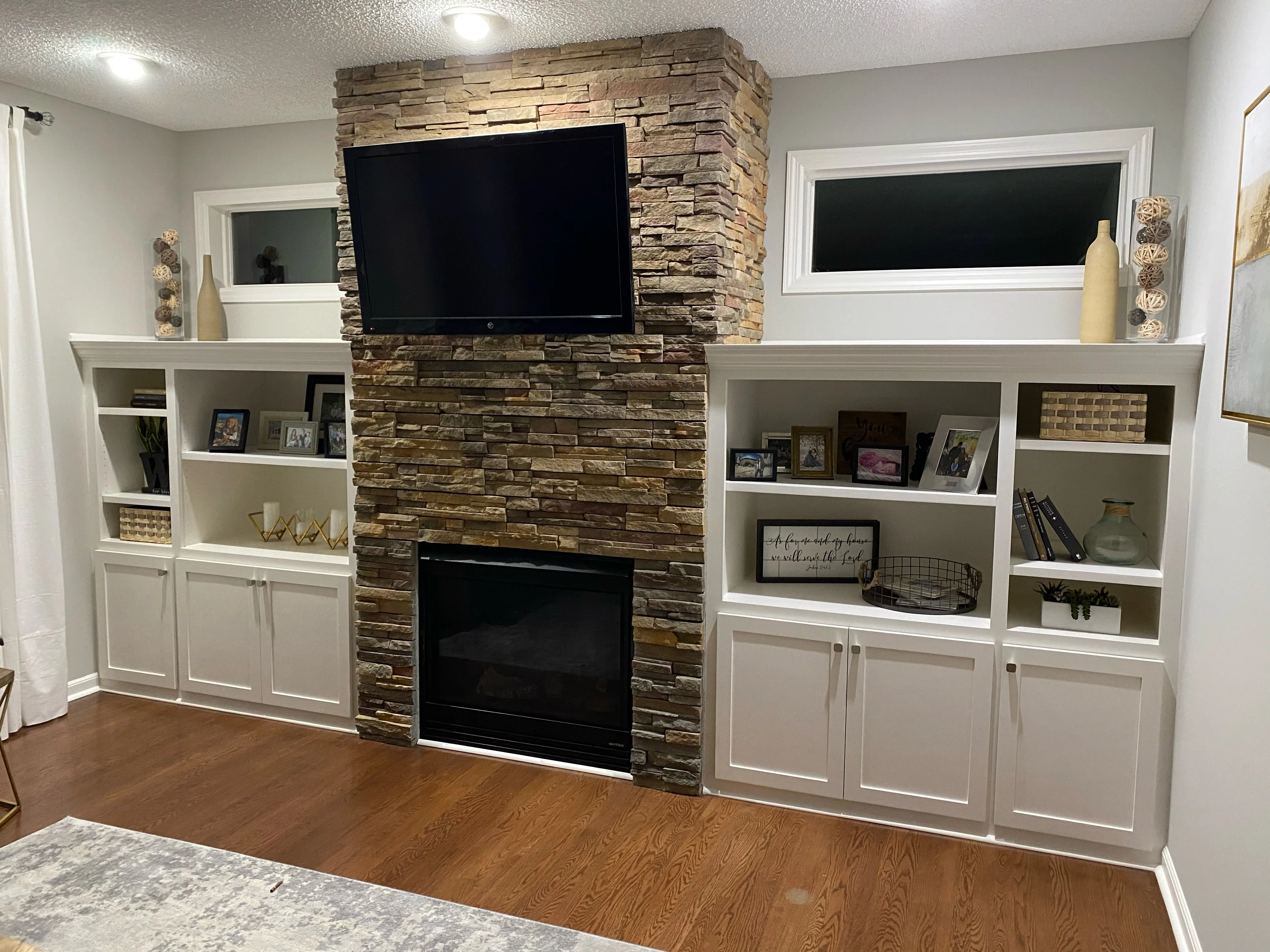
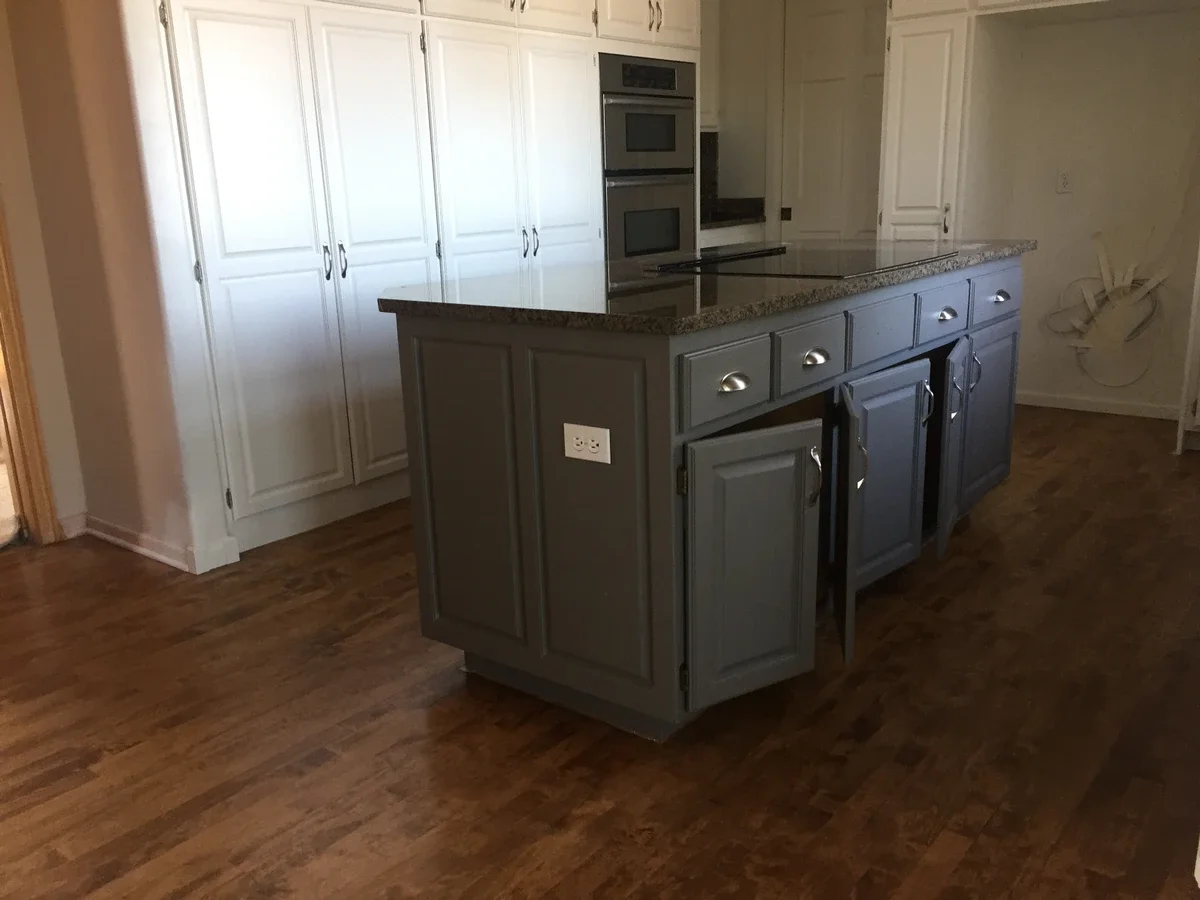
How we actually finish a kitchen: doors and drawer fronts come off and get sprayed flat in a controlled space, which is the only way to get a factory-smooth face with no roller stipple. The fixed face frames bolted to the wall get the same enamel laid off by hand where spraying them in place is not practical.

So on a typical Prestige WallWorX cabinet job the two methods are not competitors. They work together. The doors and drawer fronts, the surfaces you see and touch every day, come off and get sprayed off the boxes. The face frames that stay attached to the wall get hand-finished with the same Sherwin-Williams enamel. Both get the identical prep. That combination is what delivers a smooth result without tenting your whole kitchen in plastic for a week.

Do sprayed cabinets actually hold up better, or does that come from somewhere else
This is where the marketing and the reality part ways. The durability of a cabinet finish is set almost entirely by three things that happen before a drop of color goes on, and none of them is the application method. First, the degrease. Kitchen cabinet faces carry a film of cooking oil and hand contact that no primer bonds through, and in the outer-ring suburbs where a lot of homes run on hard well water, that film also carries a mineral residue a quick wipe will not touch. Second, the scuff-sand that gives the primer a mechanical grip on a slick, previously finished door. Third, the bonding primer itself, which is what lets the topcoat lock to the existing finish without stripping to bare wood.
"We have repainted cabinets another contractor sprayed less than two years earlier. The spray gun did not fail them. The skipped degrease did."
A sprayed finish over greasy, unsanded doors peels just as fast as a brushed one, and we have seen exactly that. So when someone asks whether sprayed cabinets last longer, the honest answer is that they last longer than a rushed brush job, and about the same as a properly prepped brush job. The finish lasts because of what is under it, not the tool that put it there. That is also why we lean on a hard, cabinet-rated enamel rather than wall paint: for the best paint for kitchen cabinets in a working kitchen you want a product built for high-contact surfaces, and we use Sherwin-Williams Emerald Urethane Trim Enamel, which cures to a hard, washable finish rated for cabinetry and trim rather than the softer coating that goes on your walls.
How to get a smooth cabinet finish, step by step
If smoothness is the goal, and on cabinets it almost always is, the finish is built in layers and the smooth surface is earned at each one. Here is the sequence we run, and none of it is optional:
1. Remove everything. Doors, drawer fronts, and all hardware come off and get labeled so each piece returns to the exact opening it came from. You cannot get an even, drip-free face painting a door in place.
2. Degrease, then scuff-sand. Every face gets cleaned with a dedicated degreaser, then lightly sanded so the primer has something to grip. On a hard-water home we run the degrease longer, because the mineral residue is the thing that quietly wrecks adhesion.
3. Bonding primer. A primer built for slick, previously finished surfaces, and on stained oak or cherry a stain-blocking primer so the natural tannins cannot migrate up and yellow a light color.
4. Grain-fill if the wood demands it. Open-grain species like oak telegraph their grain straight through enamel as tiny valleys, so when a client wants a truly smooth painted face over oak, we fill the grain before the topcoat.
5. Spray thin, cured coats. The doors get sprayed flat in thin, controlled passes rather than one heavy coat. Thin coats level flat and cure hard. Heavy coats sag, trap solvent, and stay soft for months.
6. Sand between coats. A light sand knocks down any dust nibs so the next coat lands on a clean, smooth base. This is the step homeowners almost always skip, and it is the difference between a finish that feels like glass and one that feels like fine sandpaper.
Southwest metro reality: the solid 1970s to 1990s oak and maple cabinet boxes common across Burnsville, Chaska, and Eden Prairie take enamel beautifully once they are degreased and grain-filled right. The substrate, not the color, is the variable that decides how smooth the final face reads.
Want a smooth kitchen without renting a sprayer and tenting your house for a week? Request a free cabinet estimate and we will scope the job properly, or call (612) 419-2789.
When brushing is genuinely fine, and when it is the wrong call
We will not pretend every surface needs a spray booth. There is an honest line here, and it is worth drawing because a lot of homeowners spend money fighting a problem they do not have. Brushing is perfectly fine on the fixed face frames, on a small built-in, on a single vanity cabinet, or on any surface where the light does not rake across a wide flat panel. A careful hand with a self-leveling enamel and a fine brush, laid off in one direction with a light touch instead of overworked, gets a result on those surfaces that nobody will ever notice is not sprayed.
Where brushing is the wrong call is the thing people most want to brush: the wide flat face of a cabinet door, especially in a light color. White and other pale enamels light up brush ridges like a topographic map, because there is no pigment depth to hide the texture. If you are set on a smooth white kitchen, spraying the doors off the boxes is not a luxury, it is the only way to get there. Trying to brush that and accepting the stipple is the compromise most DIY cabinet jobs end up making, and it is the first thing we are called to fix.
When painting your cabinets is the wrong call entirely
Separate from spray versus brush, there is a case where neither method is the answer, and we would rather say so before we quote than after we spray. Do not pay us to finish cabinets if the boxes are particleboard already swelling or delaminating at the sink base from a slow leak. Paint is lipstick on a failing box, and those specific cabinets are better replaced. Do not spray or brush over a thermofoil or laminate wrap that is already peeling at the corners, because enamel will not re-bond a wrap that is lifting. And if your doors are structurally fine but you genuinely hate the door profile, that is a shape problem, not a finish problem, and no amount of spray will change a raised-panel door into a Shaker. If you are weighing the bigger question of refinishing versus swapping the fronts, we walk through whether to repaint or reface first in detail, because getting that call right saves you the most money of any decision in the project.
Do sprayed cabinets last longer than brushed?
Not on their own. A sprayed cabinet finish lasts about 8 to 15 years under normal kitchen use, and so does a properly prepped brushed one, because the lifespan is set by the degrease, the scuff-sand, the bonding primer, and a cabinet-rated enamel, not by the spray gun. What spraying buys you is a smoother, more even surface with no brush ridges or roller stipple, which is a real benefit on the flat faces of doors and drawer fronts where the eye lands. Where a sprayed finish does quietly help durability is film evenness: a uniform, thin, fully leveled coat has no thick spots that stay soft or thin spots that wear through early. But a sprayed finish over greasy, unsanded doors still peels fast. The method decides how it looks. The prep decides how long it lasts.
Why do painted cabinets peel?
Painted cabinets peel for one reason almost every time, and it is not the paint or the application method. It is a prep step that got skipped to hit a low bid. The single biggest failure mode we get called to fix is peeling from skipped degreasing: kitchen faces carry a film of cooking oil and hand contact, heaviest around the range and the pulls, and no primer bonds through grease, so the finish releases in sheets within a season. The second is skipping the scuff-sand that gives primer a mechanical grip on a slick previously finished door. The third is laying on heavy coats that trap solvent and stay soft instead of thin coats that cure hard. A separate, specific cause out here in the southwest metro is hard well water: the mineral residue it leaves on cabinet faces blocks adhesion the same way grease does, which is why we run the prep longer on well-water homes around Chaska and Waconia. If your cabinets are already peeling, they need a strip-prime-reset through our kitchen cabinet refinishing process, not another coat sprayed over the top of a finish that is already letting go.
Get a smooth, lasting cabinet finish in the Twin Cities
Spray versus brush is the wrong thing to lose sleep over. We spray the doors and drawer fronts for the smoothest face, hand-finish the frames, and put the same meticulous degrease, scuff-sand, and bonding primer under every surface, because that prep is what actually decides whether your finish holds for a decade or fails in a season. That full process lives on our cabinet painting service page, and when the existing finish has already failed, our kitchen cabinet refinishing option is the strip-and-reset route. Prestige WallWorX is owned and run by Gene out of Victoria, with 104 five-star Google reviews earned across 16 years of cabinet, interior, and exterior finishing in the southwest metro. Request a free cabinet estimate or call (612) 419-2789, and we will walk your kitchen, flag any surface that should be replaced instead of painted, and quote the smooth finish you actually want.
Our Recent Work
A look at the custom finishes, cabinetry, and interiors we've transformed across the Twin Cities.
Imagine what we could do for your home.
Call (612) 419 2789Ready for a fresh, flawless finish?
Free, no-pressure estimates across the Twin Cities metro.